

Views: 0 Author: Site Editor Publish Time: 2026-08-12 Origin: Site


A sliding door tucked neatly into a wall saves valuable floor space. It also creates a clean, architectural transition between rooms. However, when these hidden mechanisms begin to grind, stick, or derail, the magic quickly fades. Replacing broken components inside a wall often requires cutting open finished drywall. This transforms a simple hardware failure into an expensive, labor-intensive remodeling nightmare. You need a highly reliable solution to avoid tearing apart your home twice.
We designed this guide to provide a technical, no-nonsense framework. You will learn how to accurately evaluate and select replacement components. We help you prioritize long-term reliability, architectural standards, and professional installation realities over minor aesthetic preferences. Fixing your door permanently requires understanding the underlying mechanics. Keep reading to discover how to choose compatible replacement hardware and prevent future failures.
Hardware matching is critical: Selecting compatible replacement hardware requires precise measurements of door weight, thickness, and existing header dimensions.
Track profile dictates reliability: Heavy-duty box tracks drastically reduce the risk of rollers "jumping" compared to standard J-tracks.
Roller material matters: Commercial-grade, multi-wheel ball-bearing rollers outperform standard nylon wheels in longevity and acoustic performance.
Labor outpaces parts: Investing in premium pocket door hardware upfront is always more cost-effective than a secondary drywall teardown.
You cannot accurately troubleshoot a failing sliding system without understanding how the parts interact. Diagnosing an issue requires identifying the exact component failure. When auditing your pocket door hardware, you must know what each piece does. This knowledge prevents you from buying incompatible parts. It also helps you determine if a simple repair will suffice or if you need a complete system overhaul.
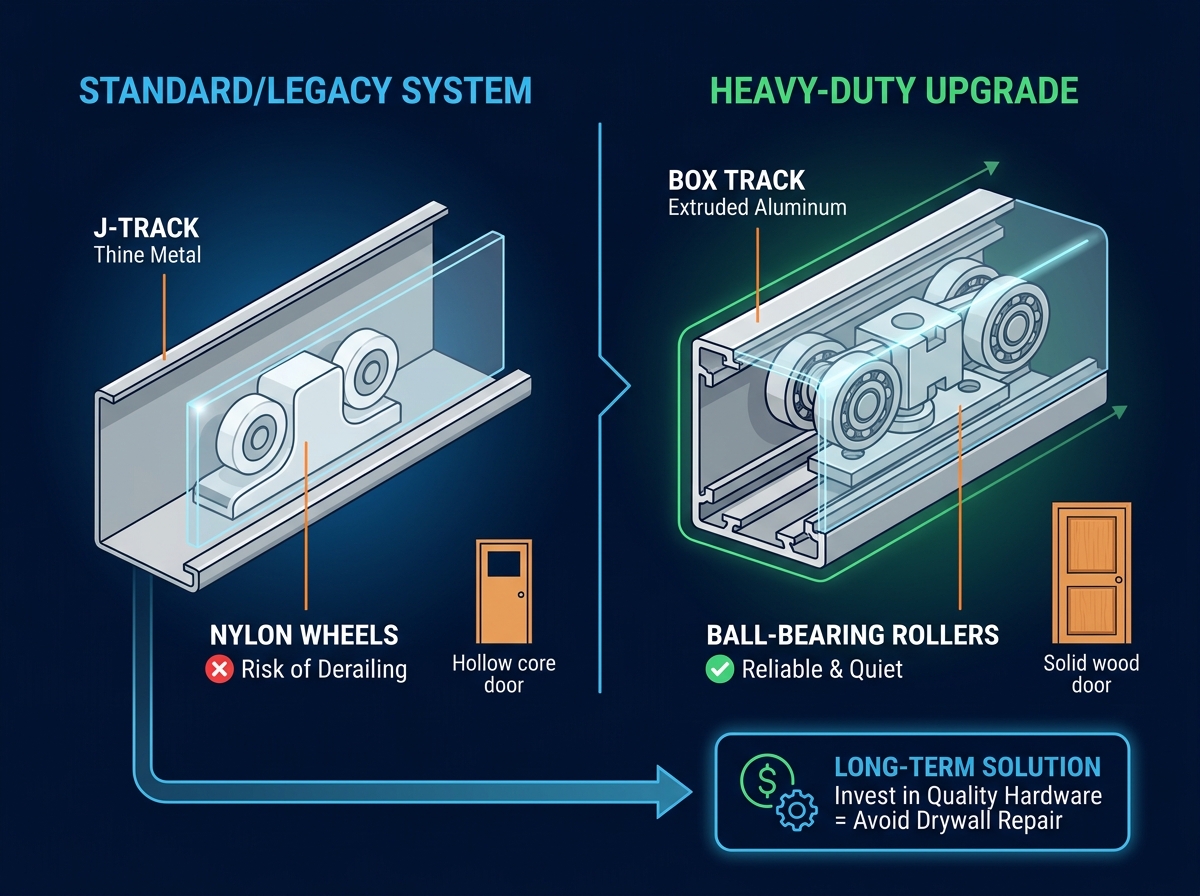
The header track bears the entire dynamic load of your door. It acts as the structural foundation for the moving panel. Standard residential tracks usually consist of thin, stamped sheet metal. These cheaper profiles bend easily under heavy loads or constant use. In contrast, commercial profiles use extruded aluminum. Extruded aluminum provides a highly rigid, rust-proof channel. This robust material resists warping over time. It guarantees a smooth gliding surface even as a house settles.
Rollers glide inside the header track to move the door back and forth. Installers often call them trucks or hangers. Basic residential kits include standard twin-wheel hangers. These entry-level rollers use simple friction bearings. They work fine for very light panels but wear out quickly under stress. Heavy-duty systems rely on three-wheel or four-wheel ball-bearing trucks. These advanced trucks distribute the door weight evenly across multiple contact points. They reduce friction, ensuring a silent and effortless glide.
Many homeowners overlook the bottom guides. However, these floor brackets play a critical role in system health. They prevent the door panel from swaying laterally. They also stop the bottom edge from scraping against the door frame. Poor bottom guides allow the panel to swing. This lateral sway exerts destructive shear forces on the upper rollers. Consequently, weak bottom guides often accelerate upper roller wear. Properly installed floor brackets extend the lifespan of the entire overhead mechanism.
Selecting replacement components requires strict evaluation criteria. You must match the hardware to your specific structural needs. Making assumptions about load capacities or wheel materials leads to premature failure.
You must accurately assess your door material to determine its weight. Hollow core doors usually weigh very little, while solid wood or glass panels carry significant mass. We created a matrix to help you choose the right capacity.
Door Type | Estimated Weight Range | Recommended Load Rating | Ideal Roller Configuration |
|---|---|---|---|
Hollow Core | Under 50 lbs | 75 lbs minimum | Twin-wheel nylon |
Solid Wood / MDF | 50 to 150 lbs | 200 lbs minimum | 4-wheel ball-bearing |
Oversized / Glass Insert | 150 to 200+ lbs | 250 to 300 lbs minimum | Commercial 4-wheel steel |
Never rely solely on manufacturer weight maximums. Always build in a twenty percent safety margin. If your panel weighs one hundred pounds, purchase a system rated for at least one hundred and twenty pounds. This safety margin guarantees long-term smooth operation and minimizes friction wear over the years.
Track shape heavily influences reliability. Older homes typically feature J-tracks. A J-track resembles the letter "J" and allows the rollers to rest on a single lower lip. They cost less to manufacture. However, they are highly prone to derailing. If the door bounces or shifts unexpectedly, the wheels jump right off the lip.
Box tracks offer a vastly superior alternative. A box track captures the rollers entirely inside an enclosed aluminum channel. The wheels cannot escape the track housing. Architects and professional contractors consider the box track the gold standard for reliability. It virtually eliminates the frustration of a derailed sliding door.
Wheel material directly impacts acoustic performance and durability. Plain nylon wheels run quietly. Unfortunately, plain nylon degrades quickly under heavy loads. The wheels eventually flatten, causing a bumpy, erratic glide. Precision steel ball bearings covered in nylon tires offer the optimal solution. The steel core handles massive weight without deforming. Meanwhile, the outer nylon tire dampens sound. This combination delivers the best balance of acoustics and long-lasting durability.
Commercial spaces and aging-in-place renovations require strict ADA compliance. The Americans with Disabilities Act dictates specific pull force requirements. Interior sliding panels must typically open using five pounds of force or less. You must also maintain a clear opening width of at least thirty-two inches. Keep these rules in mind when selecting heavy panels or specialized components. Certain mechanisms increase the initial pull force, potentially violating accessibility standards.
Homeowners frequently debate whether to swap broken parts or replace the entire system. Each approach carries distinct financial and mechanical implications. You must weigh immediate convenience against long-term peace of mind.
A direct replacement involves swapping old rollers for identical new ones. This makes sense when facing tight budget constraints. It also serves as a good temporary fix for rentals. Sometimes, you possess identical backup hardware from the original installation. In these cases, a direct swap saves time.
However, you must consider the hidden risks. Finding exact legacy track profiles is notoriously difficult. Manufacturers constantly update their extrusion shapes. Mixing an old, worn track with brand-new rollers often leads to accelerated wear. The old track likely contains microscopic grooves and friction patterns. These imperfections will chew through new wheels remarkably fast.
Tearing out a cheap J-track and upgrading to a commercial-grade box track system is highly recommended. It represents the most financially sound decision for long-term ownership. You might spend slightly more on materials today. You might also pay a contractor for a few extra hours of labor. Yet, this upfront investment prevents a secondary failure. A heavy-duty upgrade ensures you will not pay for another drywall teardown five years from now.
Many homeowners want to add soft-close mechanisms during a repair. These devices catch the door panel and gently pull it shut. They prevent aggressive slamming. They also protect the wooden door framing from impact damage.
You must evaluate the drawbacks before purchasing these dampers. Soft-close mechanisms require more pull force to initiate movement. You must overcome the spring tension to open the door. Furthermore, these dampening devices are highly sensitive to unlevel tracks. If your header drops even a fraction of an inch, the soft-close trigger may fail to engage. You must ensure perfect alignment to reap the benefits.
Even the best components will fail if installed incorrectly. Pocket door repairs present unique structural challenges. You must understand what the installation entails before buying your materials.
Many people ask if they can avoid drywall repair. You must clearly understand when drywall removal is mandatory. Replacing the header track always requires cutting into the wall. You cannot extract a fifty-inch metal extrusion through a narrow opening. You must expose the rough framing.
Conversely, you can sometimes avoid drywall removal if you only need to replace the rollers. If your existing track features a specialized drop-out slot, you can slide the old rollers out. You usually remove the decorative door casing and trim to access this slot. If the track remains in perfect condition, swapping rollers through the opening saves immense time and money.
Gravity constantly acts upon sliding systems. Even premium components will fail if the header is not perfectly plumb and level. If the track slopes downward, the door will drift closed on its own. If the track slopes upward, you will struggle to push the door open. Installers must use long spirit levels and precise shims to guarantee a perfectly horizontal header. You cannot rush this step. Tight tolerances dictate the success of the entire project.
Always double-check your physical dimensions before finalizing a purchase. Detail the necessity of checking door thickness allowances. Most standard kits accommodate doors measuring one and three-eighths inches thick. If you own a thicker solid wood door, you need a specialized wide-bodied track kit.
Additionally, review the track length cutting requirements. Manufacturers sell tracks in standard lengths. You often need to cut the aluminum channel using a hacksaw to fit your specific rough opening. Measure twice, factor in the bumper stops, and cut once. Mistakes here ruin the metal extrusion.
You are now ready to evaluate products on the market. Follow this precise shortlisting logic to secure the correct replacement system. Skip any step, and you risk buying incompatible parts.
Step 1: Audit the Existing Setup. Measure the door panel thickness precisely. Weigh the door if possible. If you cannot remove it, estimate the weight based on the core material. Finally, measure the rough opening dimensions to ensure you buy a long enough track.
Step 2: Prioritize the Track Profile. Filter your search options immediately. Exclude cheap J-tracks. Focus exclusively on box-track designs. This single filter physically prevents future roller jump and guarantees better performance.
Step 3: Select the Rollers. Review the load ratings for the remaining kits. Match the roller capacity to your estimated door weight. Remember to add your twenty percent safety margin. Select steel ball bearings wrapped in nylon for the quietest operation.
Once you gather these specifications, you need an actionable next step. Direct your attention to manufacturer spec sheets. Use online product selection tools to input your dimensions. Verifying the exact measurements against technical drawings ensures a flawless installation.
Pocket doors provide incredible utility, but they are only as good as the hardware supporting them. A failing system causes daily frustration and threatens your interior walls. You now understand how track profiles, roller materials, and weight capacities dictate performance.
Reiterate this core principle: spending marginally more on premium box tracks and multi-wheel ball-bearing rollers acts as essential insurance. It protects you against costly future wall repairs and ongoing maintenance headaches. Do not compromise on hidden mechanisms. To finalize your project, browse heavy-duty replacement kits today or contact support for professional compatibility checks.
A: It depends on the repair. You can sometimes swap rollers without cutting drywall. You achieve this by removing the door casing and accessing the track's drop-out slot. However, replacing a bent or damaged track almost always requires cutting drywall to expose the structural framing.
A: Several culprits cause derailment. Worn nylon wheels lose their shape and slip. Bent J-tracks fail to secure the rollers properly. Additionally, house settling can cause the header to become unlevel. Upgrading to an enclosed box-track system permanently solves this jumping issue.
A: No. While manufacturers produce tracks for standard door widths, the actual track profiles vary wildly by brand. Mounting hole alignments, extrusion heights, and roller groove widths differ significantly. You rarely find a universal track profile across different manufacturers.
A: It depends heavily on existing track compatibility and overhead clearance. Most soft-close dampers only fit specific proprietary track profiles. Adding them to an older, basic track is rarely possible. It often requires a full system upgrade to a modern, heavy-duty track designed for dampeners.


