

Views: 0 Author: Site Editor Publish Time: 2026-08-04 Origin: Site


Choosing the right components for a sliding system carries high stakes. Once contractors put up the drywall, fixing a jammed track becomes a nightmare. Replacing a broken roller turns into a costly, invasive demolition project. Builder-grade kits often lead to frustrating, derailed, and noisy doors. You want to avoid these cheap setups entirely. Instead, look toward commercial-grade and architect-approved systems. They deliver smooth, silent operation for decades. This guide provides an evidence-based framework to evaluate pocket door hardware based on structural load, track geometry, and long-term reliability. Our approach ensures you specify the exact right system the first time. We will walk you through weight thresholds, track materials, and roller mechanisms. You will learn how to bypass standard big-box pitfalls. We strip away the marketing jargon. You get pure, actionable facts.
Always spec hardware rated for at least 50% more than your door’s actual weight to account for kinetic force and structural settling.
Box-style tracks with 4-wheel ball-bearing hangers are the industry standard for preventing door derailment.
Solid-core and glass doors require heavy-duty extruded aluminum tracks to prevent microscopic sagging (deflection) over time.
Integrating features like soft-close mechanisms requires specific track sizing and precise installation to avoid future maintenance access issues.
Many homeowners make a critical mistake during renovations. They treat sliding systems like standard swinging doors. They opt for basic kits from big-box stores. This decision often backfires terribly. You might save $50 upfront on lower-tier components. However, this savings often results in a $1,000+ repair bill later. When a cheap track bends or a roller snaps, you cannot simply unscrew it. Opening the wall to fix a broken system requires tearing out drywall. It demands re-mudding, sanding, and repainting the entire section.
We must define what a successful installation looks like. A successful setup guarantees zero track-jumping. It provides whisper-quiet operation every single time you slide the slab. Furthermore, it ensures zero deflection in the header over a 20+ year lifespan. You should barely hear a hum as it moves. The panel should glide effortlessly using only one finger.
Professional carpenters and architects understand this reality well. They universally reject standard, pre-packaged hardware sets. Instead, they favor customized component selection. They mix and match tracks, rollers, and guides based on specific project demands. They treat the internal mechanism as permanent infrastructure. You should adopt this exact mindset before finalizing your blueprints.
Your evaluation must begin with accurate weight calculations. Weight classifications represent the foundational metric for any sliding system. If you miscalculate this number, even premium components will eventually fail under continuous stress.
We divide systems into three primary weight classes:
Standard Duty (Up to 125 lbs): You should use this class primarily for hollow-core interior panels. They work well for small closets or lightweight bathroom privacy partitions.
Heavy Duty (150–200 lbs): This tier is strictly required for solid wood, MDF, and standard glass panels. It handles heavier daily use without premature track wear.
Commercial/Extra Heavy Duty (250–400+ lbs): You need these robust systems for oversized, custom architectural entryways. They also support heavy steel and glass fabrications perfectly.
You must also apply the "Kinetic Buffer" rule. Sizing up the weight capacity is highly recommended. A door rarely just hangs statically. You pull it, push it, and sometimes slam it shut. This movement generates kinetic force. A 100 lb door should ideally ride on a 150 lb-rated track. This 50% buffer ensures bearing longevity. It absorbs dynamic shocks effortlessly over decades of use.
Next, evaluate slab thickness compatibility. Standard residential clearances usually dictate 1 ⅜” to 1 ¾” thickness limits. Thicker slabs require wider pocket frames. Door thickness directly impacts your choice of bottom guides. It also dictates your framing width. For instance, a standard 1 ⅜” slab fits typical 2x4 framing. Conversely, an oversized 1 ¾” solid oak slab often demands 2x6 framing. This extra space prevents the wood from rubbing against internal studs if it slightly warps over the years.
Here is a quick reference guide for evaluating capacity tiers:
Duty Rating Category | Maximum Load Capacity | Ideal Application Scenarios | Minimum Buffer Recommendation |
|---|---|---|---|
Standard | 125 lbs | Hollow-core slabs, light utility closets | Rate for 180+ lbs if used daily |
Heavy | 200 lbs | Solid core wood, heavy MDF, glass inserts | Rate for 300+ lbs if oversized |
Commercial | 400+ lbs | Welded steel frames, architectural custom | Consult a structural engineer |
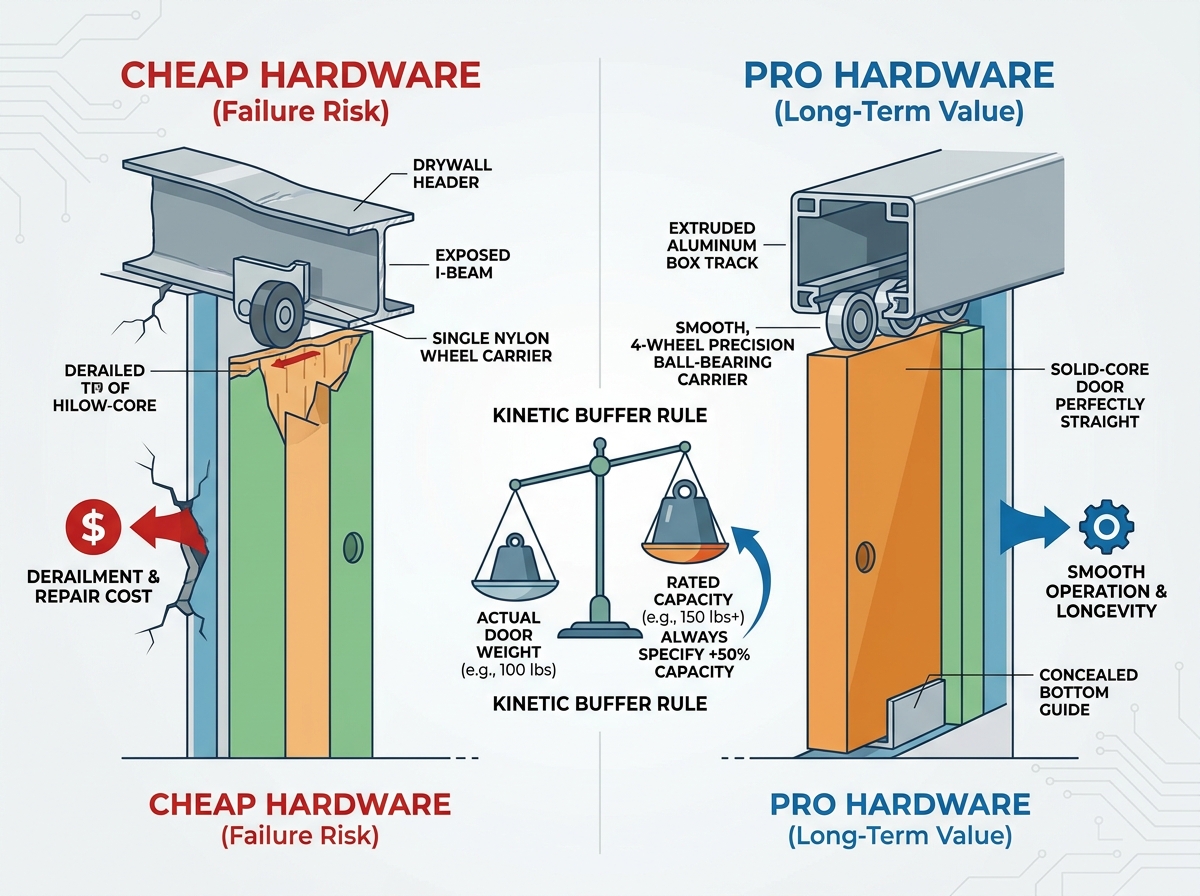
Geometry matters immensely when evaluating extrusion profiles. The shape of the metal channel dictates how securely the wheels stay in place. You will generally encounter two distinct styles on the market: box tracks and I-beam tracks.
Box tracks represent the modern industry standard. They feature an enclosed, folded design. We highly recommend them for preventing frustrating jump-offs. The wheels are completely captured inside the aluminum channel. Because the rollers sit inside this enclosed lip, upward force cannot dislodge them. Even if someone aggressively yanks the handle upward, the wheels remain trapped securely inside the box profile. They simply cannot derail.
Conversely, I-beam tracks represent older, legacy systems. These exposed designs feature wheels sitting loosely on top of the track ledge. They remain highly susceptible to derailment. Dust and debris easily settle on the exposed rails, creating speed bumps. An aggressive pull or a slight bump can easily knock the wheels completely off the ledge. We advise avoiding I-beam profiles for enclosed wall applications entirely.
Material science plays an equally critical role in system longevity. You must choose between extruded aluminum and galvanized steel.
Extruded aluminum stands as the premium standard. It resists rust naturally. This makes it ideal for damp bathroom environments where humidity destroys inferior metals. More importantly, aluminum allows manufacturers to create thicker structural profiles without adding unnecessary weight. This rigid thickness minimizes deflection. Deflection happens when the track sags microscopically under heavy loads. Over years of use, zero deflection keeps the rolling action completely smooth.
Galvanized steel offers high tensile strength. However, manufacturers often use thinner steel profiles to keep shipping weights low. These thinner steel profiles can warp or bend under heavy dynamic loads. If a steel channel bends even slightly, the rollers will catch and grind at that specific spot forever.
Your track serves as the highway. The roller mechanisms act as the vehicle. You must scrutinize the hanger system just as closely as the extrusions.
First, consider the wheel configuration. Manufacturers typically offer 3-wheel (tricycle) or 4-wheel carriers. Tricycle designs often struggle to balance heavy loads perfectly. They tend to tilt under pressure. We establish 4-wheel designs as the baseline standard. Four wheels provide beautifully even weight distribution across the metal surface. They prevent the hanger plate from tilting, binding, or scraping during motion.
The silence factor depends entirely on your bearing types. You will encounter two main options.
Nylon wheels without internal bearings rely entirely on friction. They glide directly on an internal steel pin. These friction-based wheels perform adequately for very lightweight panels. However, they are highly prone to flat-spotting if left stationary for long periods. If you leave a heavy slab open for a month, the nylon compresses against the track. It develops a permanent flat spot. This causes an annoying "thump-thump" noise every time you use it thereafter.
Precision ball bearings represent machine-grade quality. They offer the absolute best balance of silent operation and load distribution. Premium manufacturers use sealed ball bearings. They encase these metal bearings inside Delrin or high-density nylon tires. The sealed design keeps drywall dust out of the lubricated metal balls. The Delrin outer tire provides a soft, whisper-quiet ride against the aluminum channel.
You must also demand quick-release hangers. These specialized mounting plates attach to the top edge of the slab. They feature a locking latch mechanism. Quick-release plates hold critical importance for future maintenance. They allow you to remove the slab from the rollers without tearing into the drywall. You simply use a small wrench to unlock the latch, tilt the panel, and slide it out. This feature alone saves countless hours during installation and makes future adjustments completely painless.
Modern sliding systems offer several mechanical upgrades. You must carefully weigh their functional benefits against potential installation risks.
Soft-close and soft-open mechanisms have become highly popular requests. They operate similarly to high-end kitchen cabinet drawers. The primary benefit is obvious. Soft-close hardware prevents aggressive slamming. It catches the moving panel and pulls it gently to the strike jamb. This gentle action extends the life of the internal wall frame. It also protects delicate glass inserts from shattering due to sudden impact.
However, you must acknowledge the risks involved. These mechanisms add significant mechanical complexity to the setup. The soft-close activators require precise leveling during installation. If the track sits slightly out of plumb, the catch mechanism will fail to engage properly. Furthermore, these long pneumatic tubes limit the minimum panel width. They often require slabs measuring at least 28 inches wide to accommodate the physical hardware length.
Bottom guides represent another critical, often overlooked accessory. You must strongly warn your contractors against cheap plastic floor guides. Builders often screw these directly into the finished floor. They stick out, look ugly, and frequently scratch the beautiful wood finish on your panels.
Instead, we strongly recommend concealed bottom channels. You route a continuous groove into the very bottom edge of the door. A small, invisible guide pin mounts securely to the floor just inside the opening. The slab glides perfectly over this hidden pin. This method delivers a zero-wobble, completely invisible guide system.
Finally, consider converging kits. You need these when two panels meet in the middle of a wide room opening. Converging kits require specialized hardware. They utilize specialized bump stops mounted securely inside the track. These stops prevent the two heavy slabs from bypassing each other or slamming together violently.
Even the absolute finest components will fail if you execute the installation poorly. Architects insist on strict best practices long before the drywall goes up.
Header rigidity dictates everything. The best track will fail if the rough framing header sags. Many framing crews use standard pine 2x4s for headers. Pine bows naturally over time due to moisture variations and structural load. We emphasize the absolute need for engineered lumber. You must use Laminated Veneer Lumber (LVL) headers above the opening. LVL utilizes advanced structural glues to remain perfectly straight. It resists all microscopic bowing. If the header stays straight, the track stays straight. Installers should also use laser levels to shim the track perfectly horizontal.
Maintenance accessibility should guide your decision stage. Here is a pro-tip: ensure the chosen track system allows rollers to be removed or replaced. You should be able to access them through the main opening without removing the finished casing trim. High-end tracks feature a removable section or a wide enough gap to slip a new roller set in easily.
Follow this shortlisting logic to finalize your choices:
If your budget is strict and you have a hollow door: Choose a standard enclosed box track with 4-wheel nylon friction rollers.
If you have a solid core door seeing daily use: Demand an extruded aluminum track. Ensure it holds a 200 lb rating and features sealed ball bearings.
If you are hanging oversized glass panels: Specify commercial-grade aluminum with machine-grade 4-wheel Delrin bearings and an LVL engineered header.
You must treat these concealed systems as a permanent infrastructure investment. They are not merely a finishing touch like a cabinet knob or a light switch cover. By sizing up your weight capacity and choosing enclosed aluminum tracks, you guarantee decades of flawless operation. Specifying four-wheel ball-bearing hangers eliminates the frustrating noises and scraping associated with cheap builder-grade kits. The right initial choices save you thousands in future demolition costs.
Take direct action today to secure your investment. Measure your exact slab height, width, total weight, and thickness. Assess your current wall framing carefully. Check whether you have standard 2x4 studs or deeper 2x6 cavities before purchasing any components. If you require specialized configurations or want to discuss specific project details, please feel free to contact us for expert guidance. Taking these careful steps now ensures your walls remain closed and your doors slide silently for a lifetime.
A: Generally, no. Upgrading the main track requires exposing the rough header framing. You must remove the casing, jambs, and adjacent drywall to access the track screws. However, if you already have a premium track with a removable access point, you might be able to swap out the roller wheels without tearing into the drywall.
A: Scraping usually stems from warped slabs, improper bottom guides, or cheap framing kits. Thin wooden split-studs found in big-box kits bend easily over time. If the slab itself warps due to humidity, it will rub against these weak studs. Installing a concealed bottom guide channel prevents side-to-side sway and eliminates scraping.
A: Yes. Once a slab exceeds 200 pounds or 36 inches in width, you must abandon standard heavy-duty kits. You should move to commercial architectural extrusions. These systems feature thicker aluminum walls, heavy-duty ball bearings, and reinforced mounting brackets designed to handle immense kinetic forces without failing.
A: Early generations of soft-close hardware were prone to failure. However, modern pneumatic mechanisms are highly durable if installed perfectly level. Spring-based mechanisms can stretch and lose tension over time. Premium pneumatic dampers offer superior longevity. Proper track alignment remains the critical factor in preventing premature failure of any soft-close accessory.


