

Views: 0 Author: Site Editor Publish Time: 2026-11-13 Origin: Site


Importing massive container-loads of architectural hardware carries immense financial and reputational stakes. Imagine outfitting a major residential project only to discover the newly installed components rust within six months of handover. Such catastrophic failures destroy profit margins and ruin hard-earned client trust. To mitigate this risk, overseas manufacturers readily provide Salt Spray Test (SST) reports to prove quality.
However, buyers frequently take these technical documents at face value without proper critical analysis. Relying on blind trust rather than verifying the data often leads to disastrous procurement decisions. We aim to provide a highly skeptical, procurement-focused framework for accurately decoding SST reports. You will learn exactly how to validate supplier quality claims and spot hidden testing red flags. By mastering this evaluation process, you can confidently secure durable products before ever committing to a bulk purchase agreement.
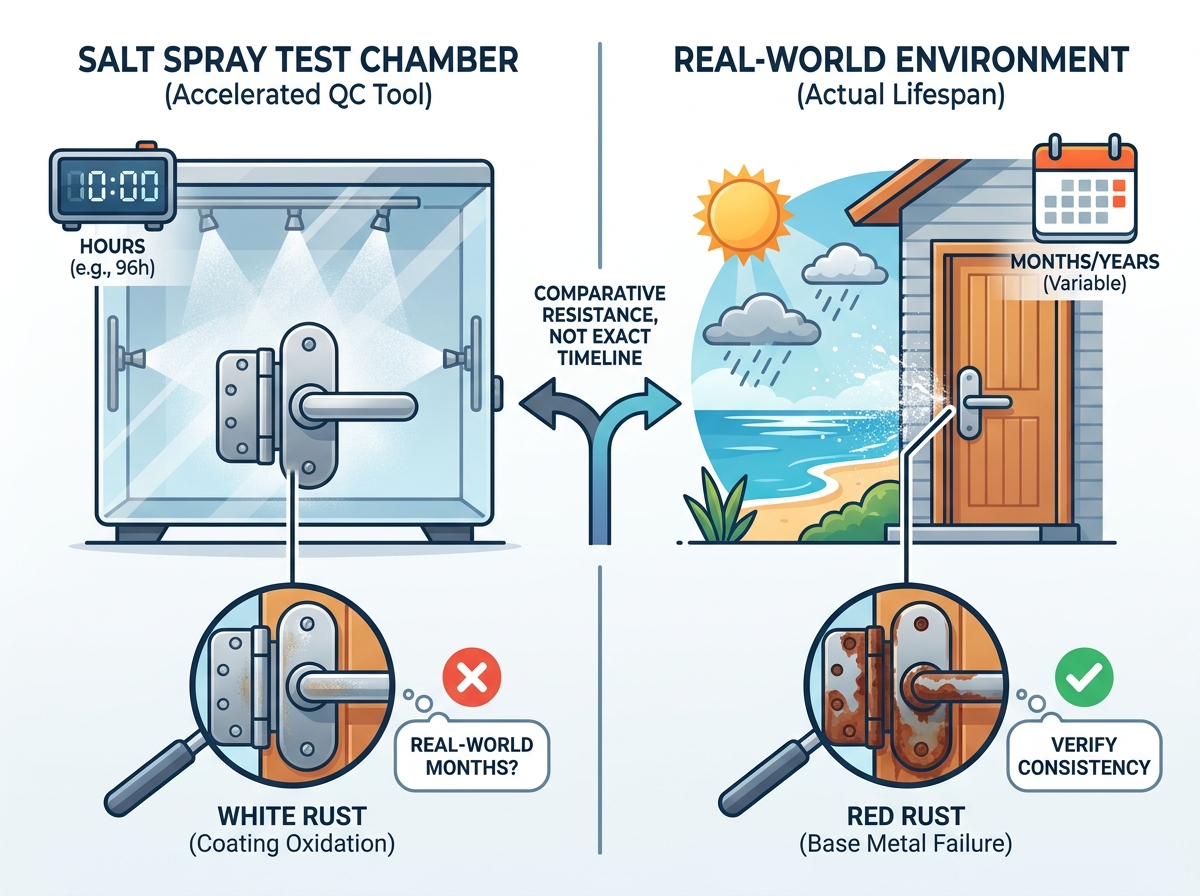
Salt spray testing (ASTM B117/ISO 9227) measures comparative corrosion resistance, not exact real-world lifespans.
Report validity hinges on understanding the difference between "white rust" (coating oxidation) and "red rust" (base metal failure).
High-friction items like door hinges require different baseline testing expectations than static hardware.
Authentic reports must specify the exact material grades and surface finish treatments to be credible.
We must first establish exactly what testing standard drives the industry. Protocols like ASTM B117 and ISO 9227 remain the globally recognized primary testing procedures. They establish the absolute baseline for evaluating OEM door hardware. Procurement teams around the world rely heavily on these specific standards to judge vendor capabilities. Yet, a massive illusion persists regarding testing duration. Many novice buyers mistakenly equate "hours in a chamber" directly to "months in the real world." They assume a 96-hour test result guarantees several years of flawless performance on a residential door.
This assumption fails spectacularly, especially in demanding coastal environments. Real-world climates introduce highly complex corrosive variables. The testing chamber simply blasts a continuous 5% saline fog over the samples. It completely ignores natural UV radiation. It bypasses daily thermal cycling. Therefore, you must reframe how you view these tests entirely.
Frame the SST purely as an accelerated quality-control tool. It primarily verifies manufacturing batch consistency. It proves the factory applied the surface coating correctly and evenly. It does not provide a definitive guarantee of product longevity in the field. Think of it as a rigid pass/fail mechanical audit. You use it to weed out inferior plating processes before authorizing shipment. If a batch fails early, the factory likely skipped a crucial cleaning step. Understanding this business reality prevents you from overpromising durability to your end-users.
Reading a technical document requires strict attention to detail. A generic, poorly formatted document often hides major manufacturing shortcuts. Legitimate reports must display specific testing parameters clearly and accurately. You must verify these core components.
Testing Parameters: The document must state the exact environmental conditions of the chamber. You should look specifically for a 5% sodium chloride (NaCl) concentration. The chamber temperature must hold perfectly steady at 35°C (95°F). Furthermore, the report must specify the exact pH range of the saline solution. The acceptable pH range usually falls between 6.5 and 7.2. Any deviation invalidates the results.
Sample Preparation Details: How the laboratory prepped the samples matters immensely. The report must thoroughly document the physical preparation steps. Did the technicians seal the raw cut edges? Did they properly degrease the hardware before initiating the test? It should also state the exact hanging angle inside the chamber. Standards typically require positioning samples at a 15 to 30-degree angle from vertical.
Pass/Fail Criteria (The Rust Threshold): You must break down the results section carefully. Differentiate strictly between cosmetic degradation and actual structural failure. White rust represents the natural oxidation of a sacrificial zinc coating. It looks chalky and unappealing, but it proves the coating works as intended. Red rust indicates catastrophic base metal failure. Red rust means the underlying steel is actively corroding.
Photographic Evidence: Never accept a text-only summary from a supplier. High-resolution photos remain absolutely mandatory. You need clear "Before," "During," and "After" images of the exact samples. These photos must include verified digital timestamps. Visual proof validates the written claims and prevents sample swapping.
Articulating components introduce a severe mechanical variable into the evaluation equation. Moving parts like door hinges face highly unique corrosion challenges. Static chamber testing rarely captures these operational realities accurately. In a standard laboratory test, the component sits perfectly still on a rack. In real life, the hinge swings thousands of times under heavy load.
This functional friction aggressively compromises most surface treatments. The constant rubbing between hinge pins and interior knuckles rapidly wears down the finish. Powder coating and electroplating quickly deteriorate at these tight metal-to-metal contact points. Once the protective coating thins out, airborne moisture penetrates the unprotected base metal. The resulting internal rust causes severe squeaking and eventual mechanical binding.
Because of this inevitable wear, you must set extremely strict baseline expectations. Standard interior residential components face minimal environmental stress. You can generally accept SST hour benchmarks between 48 and 96 hours. However, exterior components face harsh weather elements daily. Heavy-duty commercial applications demand much higher resilience to survive. For these demanding environments, demand a minimum of 240 hours. Coastal or heavy industrial installations may push this requirement well past 500 hours. Always adjust your pass/fail threshold based on the specific mechanical application of the item.
Common mistakes include applying static test standards to dynamic moving parts. You might see a beautiful 500-hour result on a locked, unmoving hinge block. Yet, that same hinge might fail quickly in a busy commercial doorway. Ask the supplier if they conduct mechanical cycling tests before the salt spray. Cycling the hinge 10,000 times before placing it in the chamber reveals true durability. This combined testing approach exposes weak plating adhesion quickly. It separates premium manufacturers from mediocre ones.
A dangerous misconception continually plagues the architectural hardware industry. Many buyers falsely believe stainless steel remains completely rust-proof in all conditions. This myth leads to rampant complacency during the procurement process. Stainless steel highly resists corrosion, but it remains vulnerable under extreme chemical conditions. Therefore, rigorous testing remains necessary even for premium alloys.
Grade differentiation plays a massive role in overall performance. You must set vastly different expectations for 304 versus 316 grade alloys. When sourcing heavy-duty stainless steel barn door hardware, exact material chemistry matters. Grade 304 handles inland moisture and standard indoor humidity exceptionally well. Grade 316 contains added molybdenum in its metallurgical mix. This critical addition dramatically boosts resistance to harsh chlorides and salt spray.
You must actively look for passivation verification in the test report. Passivation is a critical chemical bathing process using nitric or citric acid. It aggressively removes free iron particles from the metal surface. This process greatly enhances the passive chromium oxide protective layer. Unpassivated stainless steel will fail a salt spray test surprisingly fast.
Furthermore, you must identify signs of pitting corrosion on the test samples. Surface discoloration or mild tea-staining often wipes away easily with a cloth. Pitting represents a localized, deep structural failure. It creates tiny, irreversible craters in the metal surface. Pitting is far more critical than simple cosmetic staining.
Table Title: Salt Spray Test Benchmarks for Common Hardware Grades
Material Grade | Recommended SST Hours | Typical Application | Pitting Resistance |
|---|---|---|---|
304 Stainless Steel | 96 - 120 Hours | Interior / Mild Exterior | Moderate |
316 Stainless Steel | 240+ Hours | Coastal / Industrial | High |
Zinc-Plated Carbon Steel | 48 - 72 Hours | Dry Interior Only | Low |
Testing chambers operate in a strict vacuum of controlled variables. They completely ignore several harsh real-world environmental factors. You must deeply understand these limitations to make safe purchasing decisions.
Missing Environmental Factors: Chambers blast continuous fog at a steady, warm temperature. Real climates fluctuate wildly throughout the day. Tests ignore destructive UV exposure from the sun. They bypass daily temperature thermal cycling completely, which expands and contracts the metal, often cracking brittle surface finishes. They also omit industrial airborne pollutants and changing ambient humidity levels.
Galvanic Corrosion Risks: Laboratories test single materials in pure isolation. Real installations mix disparate metals constantly on the job site. Installing standard steel screws into solid brass plates creates a tiny battery. When moisture bridges these two different metals, the less noble metal acts as an anode and deteriorates rapidly. A standard chamber report fundamentally fails to account for this interactive failure.
Complementary Evaluations: You should demand secondary tests on high-risk architectural applications. Do not rely solely on continuous salt fog data. Request cyclic corrosion testing protocols. Cyclic tests purposefully alternate between wet fog, drying phases, and UV exposure. They mimic nature much more accurately. UV degradation reports also help verify powder-coat color stability over long periods.
Evaluating the exact origin of the report serves as your first defense. Factory-generated documents hold significantly less credibility in the global market. An in-house laboratory might calibrate equipment favorably to ensure passing grades. Independent laboratory certifications offer authentic peace of mind. Always look for official stamps from reputable organizations like SGS, TUV, or Intertek.
Batch traceability represents another major hurdle in quality control. Manufacturers sometimes test a specialized, highly prepped "golden sample." They heavily coat this single unit just to pass the laboratory test. You must ensure the report explicitly links to your specific purchase order. The documentation must reference the exact SKU being manufactured for your upcoming container.
Finally, you must establish strict contractual tie-ins regarding these tests. Never leave quality standards up to vague verbal interpretation. Write specific performance thresholds directly into your official supplier quality agreement (SQA). State clearly: "Maximum 5% white rust and 0% red rust at 120 hours." This exact phrasing mitigates your legal liability. It forces the supplier to absorb the financial cost of any failed batches.
Chart Title: Supplier Quality Agreement Verification Chart
Verification Step | Manufacturer Risk Factor | Buyer Mitigation Strategy |
|---|---|---|
Lab Origin Check | In-house data manipulation | Mandate independent SGS/TUV testing |
Sample Selection | Golden sample bias | Enforce PO/Batch specific traceability |
Contract Terms | Vague quality promises | Insert strict "0% red rust" clauses |
Reading an SST report correctly protects your bottom line and reputation. It fundamentally verifies manufacturer honesty and baseline coating consistency. It does not perfectly predict the exact future lifespan of the installed product. By deeply decoding these reports, you strip away slick marketing fluff and expose raw, actionable data.
Take decisive action on your next bulk hardware order. Always request independent third-party reports for initial container purchases. Establish exceptionally clear pass/fail criteria directly in your purchasing contracts. Refuse to accept generic or poorly documented test results. Hold your overseas suppliers to verifiable, rigidly documented industry standards.
A: The ideal duration depends entirely on the finish and underlying material. Standard zinc-plated items might only survive 96 hours before showing red rust. However, true exterior coastal applications demand 316 stainless steel or specialized powder coatings. These premium setups should easily exceed 500 hours without structural degradation. Always align your expectations with the specific environmental demands of the installation site.
A: Yes, falsification happens frequently in overseas procurement. Suppliers may manipulate digital photos or alter time stamps to make a test appear longer. They often test heavily coated "golden samples" instead of pulling random production units from the assembly line. Mandating independent third-party testing from certified labs heavily mitigates this risk and ensures the data reflects actual batch quality.
A: Not necessarily. For zinc-plated or galvanized items, white rust simply indicates the sacrificial coating is actively working. It is oxidizing to protect the steel underneath. As long as it remains within acceptable percentage limits, the test passes. Red rust, however, indicates catastrophic base metal failure and should trigger an immediate batch rejection.


