

Views: 0 Author: Site Editor Publish Time: 2026-11-04 Origin: Site


Bulk procurement of drying equipment carries hidden liabilities. Structural integrity failures quickly destroy wholesale profit margins. Packaging standards matter immensely at scale. Retail buyers face high stakes when placing volume orders. Hotel procurement teams evaluate massive supply runs. Commercial distributors need absolute reliability across shipping containers. You cannot rely merely on basic supplier claims. We must establish rigorous quality control criteria. You need measurable standards for raw materials. Moving parts require close, technical scrutiny before approval. Logistics planning prevents catastrophic transit damage. This guide sets a new benchmark for supplier inspections. We move beyond surface-level aesthetics and basic dimensions. You will learn to audit hinges, joints, and dynamic load limits. We also cover strict packaging drop tests. Proper vendor vetting prevents disastrous commercial return rates. By demanding precise performance metrics, buyers protect their brand reputations. Solid supply chains rely on these exact, unforgiving inspection frameworks.
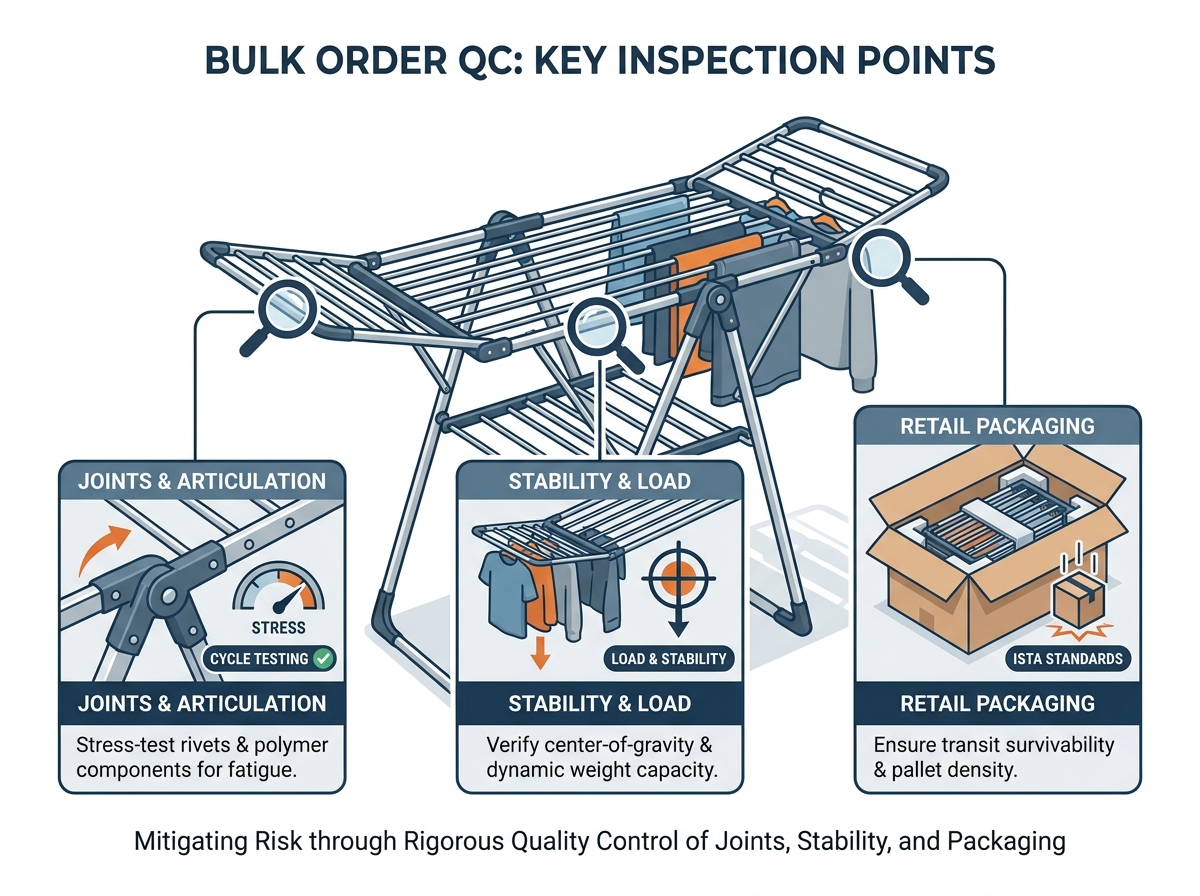
Hinge and joint failures are the primary drivers of commercial return rates; specify exact rivet and polymer requirements before ordering.
Center-of-gravity testing is non-negotiable for multi-level units to prevent tipping under uneven wet-weight loads.
Sustainable and high-capacity variants require distinct inspection protocols (e.g., moisture content for wood, weld strength for metal tiers).
Retail packaging must balance pallet-density efficiency with ISTA-standard drop protection to preserve margins.
Accepting a tiny defect rate seems harmless initially. However, a 3% failure in joint durability severely ruins wholesale return on investment. Retail consumers quickly lose brand trust when products collapse. High return rates cause logistical nightmares for commercial distributors. Therefore, establishing a baseline quality standard is crucial. You must define exact pre-shipment parameters for every order of clothes drying racks.
Setting the Acceptable Quality Limit (AQL) provides transparency. We recommend AQL 2.5 for major functional defects. Use AQL 4.0 for minor cosmetic issues. Functional defects include broken hinges or missing rubber feet. Cosmetic defects cover slight surface scratches or paint variations. Suppliers must understand these thresholds before signing the contract. A transparent AQL framework eliminates post-delivery disputes. It forces factories to monitor their own assembly lines closely.
Material realities separate professional equipment from cheap alternatives. Commercial-grade extruded aluminum resists bending under heavy strain. Stainless steel offers superior rust resistance in humid environments. Standard consumer-grade tubular steel often buckles under continuous commercial use. Tubular steel also risks internal rust if moisture enters unsealed joints. You must demand precise material grade certificates from your supplier. Do not accept vague descriptions like "high-quality metal."
Material Type | Structural Durability | Corrosion Resistance | Ideal Commercial Use |
|---|---|---|---|
Extruded Aluminum (6063) | High | Excellent | Coastal resorts, luxury retail |
Stainless Steel (304 Grade) | Very High | Excellent | Heavy-duty hotel laundries |
Tubular Steel | Moderate | Fair (Relies on coating) | Budget retail lines |
Foldable mechanisms remain the most vulnerable components. These moving parts face constant friction and varying pressure. Over time, poorly engineered joints snap under heavy garments. Articulation points dictate the overall lifespan of the unit. You must focus your inspection heavily on these specific areas. A strong frame means nothing if the central hinge fails.
Polymer components require aggressive stress testing. ABS and PP plastics often serve as connecting joints. Evaluate these plastic joints for stress whitening. Stress whitening indicates the material is stretching beyond its limit. Test them for brittleness in cold-weather scenarios. Cheap plastics shatter quickly in freezing transport conditions. Demand virgin polymer pellets rather than recycled plastic mixes. Virgin polymers retain elasticity and resist sudden impacts.
Hardware audits prevent hidden structural failures. Inspect all rivets, screws, and locking hinges closely. Rust-resistant coatings are absolutely essential for laundry applications. Request a 48-hour salt spray test to verify galvanization quality. Powder coating must cover all exposed metal edges evenly. Check the sheer strength of central structural rivets. Weak rivets shear off completely when users overload the side arms.
Cycle testing separates reliable vendors from poor ones. You must demand supplier data on open/close fatigue tests. A standard commercial rack should survive 5,000 continuous folding cycles. Set up automated cycle machines during factory audits. Verify the hinges do not loosen or warp after testing. Consistent friction ensures the rack remains stable when fully deployed.
Static weight claims routinely misrepresent real-world applications. A factory might claim a 50-pound static capacity. However, wet garments introduce complex dynamic loads. Wet denim and heavy towels sway when brushed against. This motion creates lateral stress across the entire frame. You must test units using saturated fabrics. A rack holding dry shirts might instantly collapse under wet towels.
Center of gravity diagnostics prevent tipping accidents. Test the base footprints against lateral sway forces. Hang heavy wet items asymmetrically on one side. Push the unit gently to simulate accidental bumps. The base must remain firmly planted on the ground. Multi-level units present severe tipping hazards if designed poorly. Widen the base dimensions if the unit fails this test.
Floor protection ensures commercial viability. Evaluate the base caps carefully during inspections. Demand rubberized or TPR (Thermoplastic Rubber) feet. Hard plastic feet slide dangerously on wet tile floors. They also scratch expensive hardwood surfaces in hotel rooms. TPR offers excellent anti-slip performance. It absorbs minor vibrations and anchors the unit securely.
Hang varying wet weights on alternating corners to test sway.
Measure the deflection angle of the main vertical support beams.
Conduct drag tests to ensure TPR feet do not detach easily.
Reject units displaying more than a 15-degree lean under load.
Complex structures require highly specialized QC protocols. When assessing three-tier foldable drying racks, vertical load distribution is critical. Inspect the central vertical axis for any buckling signs. Apply maximum capacity weights to the top tier specifically. The lower structural columns must not bow outward. Reinforced welding at the tier junctions prevents this vertical collapse.
Arm and clip tension directly impacts user experience. Test the rotational resistance of every movable hanger arm. Arms should hold their position without sagging under weight. Test the spring tension of all integrated laundry clips. Weak springs drop wet clothes onto the floor. Overly tight springs leave permanent indentations on delicate fabrics. Find the optimal tension balance during the golden sample review.
Space-saving logistics matter for modern retail shelves. Check the true collapsed profile dimensions against the specification sheets. Suppliers sometimes ignore folded thickness in their engineering drafts. A rack that folds flat saves immense warehousing space. If the hinge protrudes, it ruins pallet stacking efficiency. Measure the folded gap to ensure strict tolerance compliance.
Natural materials introduce unique biological risks during transit. When ordering bamboo octopus drying racks, strict moisture content control is essential. Bamboo humidity levels must remain between 8% and 12%. High moisture leads directly to mold growth during oceanic transit. Dry bamboo splits and cracks under tension. Use digital moisture meters on multiple batches before packing.
Surface finish quality dictates the premium retail feel. Audit the clear-coat sealants applied to the bamboo arms. Sealants provide splinter prevention and necessary moisture resistance. Run a cloth across the arms to check for snagging. The finish must feel completely smooth to protect delicate garments. Uneven clear-coat applications turn yellow over time, destroying aesthetics.
Aesthetic consistency defines high-end organic products. Establish strict tolerance limits for natural grain variation. Premium retail environments demand visually uniform products. Discard pieces displaying dark fungal stains or irregular knotting. Group similar grain patterns together during final assembly. This attention to detail elevates the perceived brand value significantly.
Packaging efficiency directly impacts your bottom line. Pallet density optimization is a core purchasing metric. Calculate exact box dimensions to eliminate container dead space. Shaving just one inch off a box width saves thousands. Redesign the folding mechanics if it reduces the carton footprint. Maximize the unit count per standard forty-foot shipping container.
The unboxing and assembly experience shapes customer reviews. Ensure instruction manuals are highly intuitive and properly translated. Hardware packs must be blister-sealed to prevent missing screws. Protective inserts must remain fully intact after rough handling. We recommend molded pulp inserts over standard EPS foam. Molded pulp creates less mess and appeals to eco-conscious buyers.
Transit survivability requires mandatory third-party testing. Demand ISTA transit test reports before accepting the packaging design. ISTA 3A testing covers drop, vibration, and compression scenarios. Drop the packaged unit from varying heights onto concrete. Vibrate the carton to simulate long-haul trucking conditions. The internal product must emerge completely free of scratches or dents.
Retail compliance ensures smooth intake at major chain stores. Audit the exterior packaging for accurate UPC placement. Scanners must read barcodes instantly through shrink wrap. Include clear load-bearing warnings on the box exterior. Verify all eco-friendly ink and material certifications. Major retailers reject non-compliant pallets, causing severe logistical delays.
Securing a reliable vendor requires a structured evaluation logic. Begin by requesting the golden sample. This sample represents the absolute pinnacle of their production capability. You must match this pre-production sample directly against the first bulk run. Factories occasionally substitute cheaper materials once mass production begins. Hold the golden sample at your local headquarters for direct comparison.
Third-party inspections mitigate long-distance manufacturing risks. Utilize independent QC agents like SGS or TUV. Schedule these inspections immediately prior to the final payment release. Inspectors will pull random units from the completed pallet. They will execute your AQL standards and drop tests objectively. Never rely solely on factory-provided inspection photos.
Structuring a phased rollout protects your initial capital. Structure small initial trial orders to test market reception. This mitigates financial risk before committing to annual volume contracts. A trial run exposes hidden packaging flaws or slow communication. Scale up the order volume only after a successful first delivery. Gradual scaling builds a durable, trust-based supplier partnership.
Sign a detailed QC agreement detailing AQL thresholds and material grades.
Approve the physical golden sample and lock it in a secure location.
Hire an independent agency to conduct the pre-shipment inspection.
Review the ISTA transit test data and approve the packaging.
Release the final payment only after receiving the clean inspection report.
Rigorous upfront inspection remains your strongest defense. Prioritizing joints, stability, and packaging prevents disastrous commercial losses. We strongly advise testing dynamic loads instead of relying on static claims. Always verify material grades through independent laboratory tests. Update your standard operating procedures immediately. Include specific metric-driven demands in all future supplier contracts. Force vendors to meet your exact moisture and structural thresholds. Action these steps today to guarantee superior product reliability and protect your margins.
A: We recommend an Acceptable Quality Limit (AQL) of 2.5 for major functional defects. This includes broken hinges or bent frames. We suggest an AQL of 4.0 for minor cosmetic defects like slight surface scratches. Strict adherence to these rates minimizes commercial returns.
A: Buyers should demand a standardized 48-hour salt spray test report from the supplier. This laboratory test accelerates the corrosion process. It verifies the quality of galvanization or powder coating on screws, rivets, and tubular steel frames.
A: Yes. Bamboo is a natural plant material. Most customs authorities require a valid phytosanitary certificate. This document proves the bamboo was treated for pests. You must also maintain strict moisture content levels to prevent mold during transit.
A: Optimize the folding mechanism to reduce the unit's collapsed profile. Shrinking the box thickness eliminates dead space inside shipping containers. Switching to custom molded pulp inserts also allows for tighter carton dimensions while maintaining high drop-test survivability.


