

Views: 0 Author: Site Editor Publish Time: 2026-11-09 Origin: Site


Precision drives successful architectural projects. Vague procurement requests often derail timelines and blow budgets. Submitting a loose Request for Quote (RFQ) for bespoke pieces invites disaster. It leads directly to massive pricing variances, extended production lead times, and rejected submittals from architects. Ambiguity forces manufacturers to guess your true intent. They will either pad their bids to cover unknown risks or deliver non-compliant parts.
You must shift from conceptual design to manufacturing reality. A precise RFQ protects your project schedule and ensures strict compliance with CSI Division 08 71 00 standards. It also allows your procurement teams to accurately compare apples-to-apples bids from competing manufacturers. By the end of this guide, you will learn how to standardize drawings, specify exact hole patterns, define finish requirements, and implement a foolproof sample approval process. This structured approach secures top-tier custom door hardware without unnecessary delays.
Comprehensive RFQs must include 2D/3D CAD files, precise hole pattern tolerances, and accurate door handing matrices to prevent installation failures.
Clearly define base materials and finish grades (e.g., PVD vs. electroplating) to ensure longevity and aesthetic matching across all hardware components.
Mandate a strict prototyping and sample approval process (First Article Inspection) before full production to mitigate compliance and quality risks.
Evaluate supplier bids not just on unit cost, but on documented Quality Assurance (QA) frameworks, submittal approval rates, and realistic lead times.
Procurement teams frequently underestimate the financial fallout of a poorly drafted RFQ. When you send manufacturers incomplete specifications, you trigger a cascade of expensive problems.
Incomplete RFQs result in immediate "bid padding." Manufacturers analyze vague drawings and identify undefined technical requirements. They inherently inflate prices to cover these assumed risks. If they misinterpret your design, architects will reject the downstream submittals. Rejections force the factory back to the drawing board. This loop wastes weeks of production time and severely impacts your delivery schedule. You end up paying premium prices for delayed materials.
Common Mistake: Relying solely on hand-drawn sketches or inspiration photos for a quote. You give the factory too much room for interpretation.
An effective RFQ entirely eliminates supplier guesswork. It provides a definitive baseline for the manufacturer. You must define base materials, anticipated operational loads, and specific installation environments. When you supply exhaustive details, you force vendors into standardizing their quotes. You can easily spot which supplier offers genuine value versus those cutting corners on material thickness.
Your RFQ must align perfectly with commercial building codes. You must state ADA compliance requirements clearly. Specific handle returns, operational forces, and clearance measurements are strictly regulated. Furthermore, fire ratings dictate specific melting points for hardware components. Referencing the standard CSI MasterFormat 087100 framework signals professionalism. It tells the manufacturer you expect stringent adherence to industry safety protocols.
Translating an architectural vision into a manufactured product requires flawless engineering data. Minor discrepancies in drawings lead to major failures on the job site.
You cannot rely on flat images for modern manufacturing. Provide comprehensive technical files. We recommend structuring your CAD requirements into specific formats:
2D PDF Drawings: Use these for quick visual reference, rapid quoting, and submittal review. They must include clear annotations and dimension lines.
3D STEP Files: These are mandatory for CNC machining and tooling development. They provide the precise geometry required for programming manufacturing equipment.
Highlight acceptable tolerance ranges in your RFQ. Custom hardware usually requires strict machining tolerances, often within +/- 0.005 inches. Missing tolerances give factories permission to produce sloppy fits.
Specify the critical need for a Door Handing Checklist. Incorrect handing remains the leading cause of installation delays. You must categorize every single door.
Left Hand (LH)
Right Hand (RH)
Left Hand Reverse (LHR)
Right Hand Reverse (RHR)
Create a matrix detailing these orientations. Levers and locking mechanisms often feature asymmetric designs. If the factory machines a lockset for a Right Hand door, it will fail on a Left Hand Reverse setup.
Custom designs must account for existing or planned door preps. Explain the backset dimensions explicitly. Detail the cross-bore sizes and edge-bore depths. If a wood door arrives at the site pre-drilled, your hardware must match those holes perfectly. State the required escutcheon plate sizes to ensure they cover standard prep holes completely.
Complex moving parts demand rigorous specifications. Consider exactly how elements integrate. When designing custom door hinges, you must emphasize load-bearing requirements and precise pivot points. Frequency of use dictates the internal mechanics. A high-traffic commercial entrance requires heavy-duty ball bearings and reinforced pins. Conversely, low-traffic luxury residential applications prioritize silent operation and concealed profiles over massive load capacities.
Selecting the right alloy and surface treatment prevents premature degradation. Your RFQ must eliminate subjective descriptions.
Create a strict framework for choosing substrates. Environmental exposure dictates material survival. Solid brass offers excellent workability for intricate designs but tarnishes without protection. Bronze provides a classic aesthetic and natural antimicrobial properties. Stainless steel reigns supreme for durability.
Material Selection Guide
Material Type | Best Application Environment | Key Characteristics |
|---|---|---|
304 Stainless Steel | Interior or mild exterior commercial use. | High strength, moderate corrosion resistance. |
316 Stainless Steel | Coastal, marine, or highly corrosive environments. | Superior corrosion resistance due to added molybdenum. |
Solid Brass | Luxury residential or hospitality interiors. | Heavy feel, excellent for intricate casting and plating. |
Architectural Bronze | Historical restorations or high-end entrances. | Develops a natural patina over time, highly durable. |
Differentiate clearly between finish processes. Living finishes evolve and patina over time. Electroplating offers a traditional, cost-effective metallic coating. Physical Vapor Deposition (PVD) bonds the finish at a molecular level, providing unmatched scratch and tarnish resistance.
Never use generic terms like "matte black" or "brushed gold." These descriptions vary wildly between factories. Demand precise BHMA/ANSI finish codes (such as 622 for flat black or 630 for satin stainless steel). This ensures perfect aesthetic matching across all hardware components from different vendors.
You must define requirements for concealed structural elements. Surface aesthetics mean nothing if the mounting fails. When specifying heavy architectural doors, detail the exact gauge and load capacity required for custom steel brackets and mounting plates. These hidden components ensure structural integrity without compromising the exterior design. Specify the exact fastener types and thread counts needed for secure attachment to metal or solid wood frames.
The transition from a CAD file to a physical object introduces variables. A rigid sample process protects you from bulk manufacturing errors.
Address the high risk of submittal rejection. If the manufacturer's interpretation deviates slightly from the architect's intent, the entire batch could face rejection. You must verify physical representations before approving mass production. Relying solely on digital renderings guarantees unpleasant surprises on the job site.
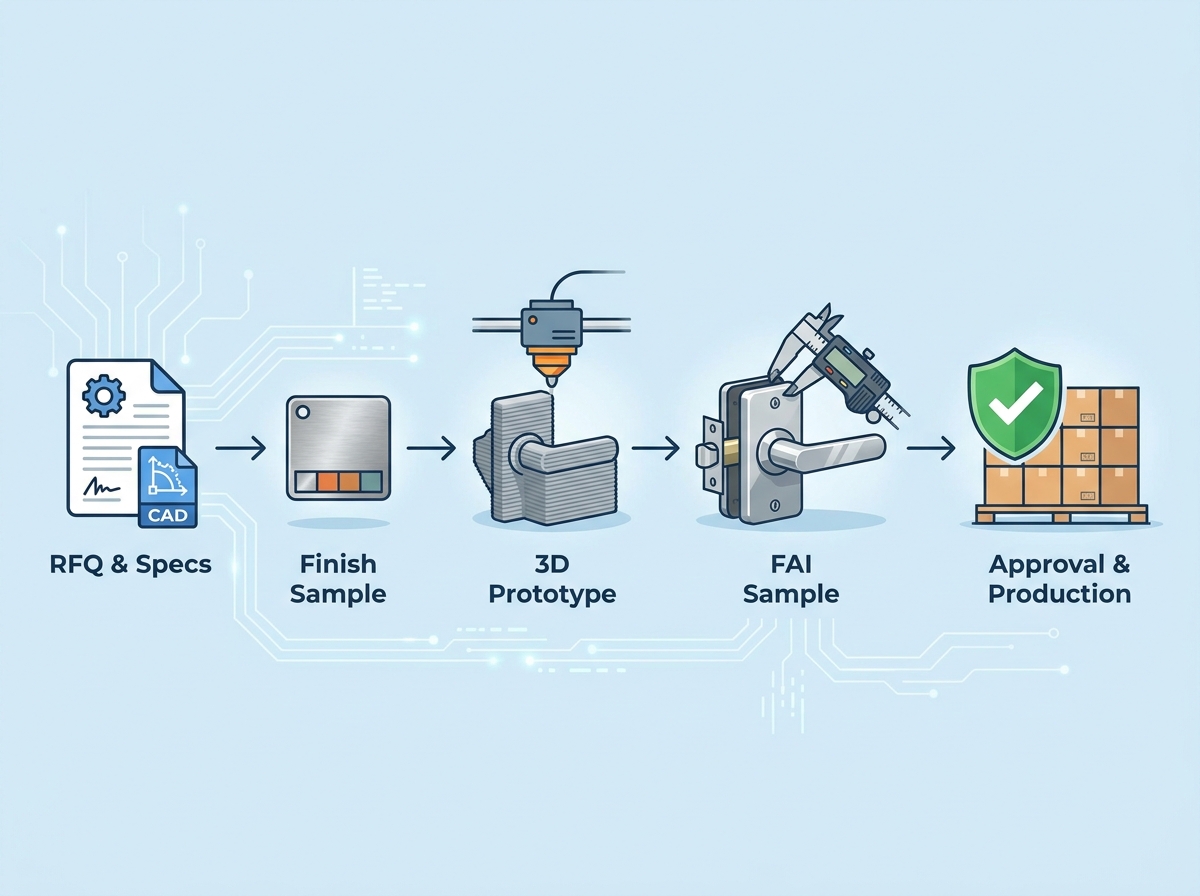
Define exactly what you expect during the prototyping phase within the RFQ. Break this down into three specific tiers:
Finish Samples: Request small metal chips (e.g., 2x2 inches). Use these to verify color consistency, gloss level, and texture against your mood boards.
3D Printed Prototypes: Request PLA or resin prints for complex levers. These allow architects to verify ergonomics, scale, and visual proportion before committing to expensive metal tooling.
First Article Inspection (FAI) Samples: Demand a fully functional, production-grade sample. This piece comes from the actual production tooling. It serves as the ultimate benchmark for form, fit, and function.
Set clear Service Level Agreements (SLAs) for sample delivery times within your RFQ. Unchecked prototyping phases easily derail project schedules. Stipulate that finish samples must arrive within two weeks. Outline a firm deadline for the FAI sample. Tie progress payments to these specific submittal approvals to maintain leverage over the production timeline.
Receiving multiple quotes feels like a win, but evaluating them improperly creates massive risk. You need a structured methodology for supplier selection.
Learn how to shortlist suppliers effectively once quotes arrive. Warn your procurement team against automatically selecting the lowest bidder. Bottom-tier pricing usually indicates hidden tooling costs. It might also mean the supplier relies on unverified offshore logistics, which introduces severe shipping delays. Look for comprehensive breakdowns. A trustworthy bid separates unit costs, tooling fees, and packaging expenses clearly.
Request that suppliers include their internal QA/QC processes directly in their bid. A manufacturer claiming high quality must prove it through documentation. Ask for specific testing protocols:
Salt Spray Testing: Verifies finish durability against corrosion. Ask for the specific hour rating (e.g., 96 hours or 240 hours).
Cycle Testing: Confirms the longevity of internal mechanisms and hinges. Demand data on how many hundreds of thousands of cycles the product withstands.
Dimensional Verification: Inquire about their measurement tools. Do they use CMM (Coordinate Measuring Machines) to verify tolerances?
Provide your team with a framework for standardizing the evaluation. Compare unit costs and tooling fees side-by-side. Map out sample lead times versus mass production lead times. Review the warranty terms carefully. A supplier offering a 10-year mechanical warranty provides significantly more value than one offering a 1-year guarantee, even if their unit price runs slightly higher.
Supplier Evaluation Chart
Evaluation Metric | Red Flags (Low Score) | Ideal Indicators (High Score) |
|---|---|---|
Pricing Structure | Lump-sum quote, no tooling breakdown. | Itemized unit cost, separated tooling fees. |
QA Documentation | Vague promises of "high quality." | Provided salt spray and cycle test reports. |
Lead Times | Open-ended delivery estimates. | Firm SLAs for samples and mass production. |
Communication | Slow replies, ignores technical questions. | Rapid response, flags CAD errors proactively. |
A meticulously detailed RFQ serves as your strongest protective asset. It forces manufacturers to commit to firm pricing, realistic timelines, and uncompromising quality standards. Leaving material specs, hole patterns, or finish codes open to interpretation directly jeopardizes your installation schedule and invites code compliance failures.
Take control of your procurement process today. Implement these actionable next steps:
Consolidate all 2D and 3D CAD drawings into a single, organized submittal package.
Finalize your material matrices using strict BHMA/ANSI finish codes.
Complete a comprehensive handing checklist for every door on the project.
Submit your structured RFQ strictly to vetted, compliance-aware manufacturing partners who demonstrate transparent QA processes.
A: MOQs vary entirely based on the manufacturing method. CNC machining requires very little setup, allowing for low MOQs (often 10 to 50 pieces). Casting or stamping, however, requires expensive mold creation. Manufacturers usually demand higher MOQs (300+ pieces) for casting to successfully offset those initial tooling costs.
A: Timelines depend on complexity. Simple finish samples usually take 1 to 2 weeks. Fully functional First Article Inspection (FAI) samples for complex locking mechanisms or bespoke hinges generally require 4 to 6 weeks. This accounts for custom tooling creation, initial machining, and internal factory testing before shipping.
A: Non-compliance creates massive liability. Building inspectors will halt occupancy, and architects will reject the installation. Your RFQ must explicitly state all required standards upfront. This allows the manufacturer to engineer necessary solutions, like specific lever returns or precise pull clearances, well before mass production begins.


