

Views: 0 Author: Site Editor Publish Time: 2026-10-22 Origin: Site


Selecting sliding door hardware is rarely just an aesthetic choice. It is a strict structural and spatial calculation. You might quickly find the wrong hardware depth compromises door core integrity. Improper clearance often causes bypass doors to scrape against each other. It can also make pocket doors jam entirely inside the wall. A successful specification demands careful balance. You must weigh ergonomic grip depth against the door's total weight. You also need precise dimensional tolerances for the door track.
This guide breaks down essential technical requirements for your projects. We evaluate flush hardware based on cutout depth and specific door thickness. You will learn how different sliding mechanisms impact your hardware selection. We cover the specific clearance rules needed to ensure smooth operation. By the end, you will understand exactly how to specify durable, functional door pulls.
Core Integrity Matters: Back-to-back installations require a minimum remaining door core thickness (typically 1/4" to 3/8") to maintain structural stability.
Clearance is System-Dependent: Pocket door hardware requires zero-profile flush installations, whereas barn door handles allow for slight surface protrusions depending on wall gaps.
Grip Depth Scales with Weight: Solid-core or commercial doors demand deeper recessed lips (minimum 3/8" to 1/2" finger purchase) to overcome initial rolling resistance.
Fastening Dictates Longevity: Mechanical fastening (concealed screws) offers superior long-term stability over friction-fit or adhesive-bound pulls.
Understanding cutout depth is a critical first step. You cannot simply select hardware based on visual appeal alone. The structural safety of the door panel dictates your options. This calculation becomes especially important when planning back-to-back hardware placements.
You must calculate the maximum allowable depth before cutting into any panel. Installing recessed flush pull handles on both sides requires precision. We use a straightforward formula to determine safety margins.
Measure the total exact thickness of the door slab.
Identify the insertion depth of your chosen exterior pull.
Identify the insertion depth of your chosen interior pull.
Subtract both depths from the total door thickness.
The remaining number represents your core material thickness.
Industry standards dictate strict structural safety guidelines. A standard interior door typically measures 1-3/8 inches thick. Installing two 1/2-inch deep pulls leaves only 3/8 inches of core material. This thin web of remaining wood creates a severe weak point. The panel may warp, crack, or fail during heavy use. You will likely require specialized mortising in these scenarios. Often, we recommend installing solid blocking inside the door stile. This blocking restores rigidity around the hardware cutout.
Closet panels or blind-side applications present fewer restrictions. Breakthrough is not a risk when hardware only occupies one face. You can maximize grip ergonomics here. Single-sided depth allowances let you specify much deeper cups. A 3/4-inch deep recess provides excellent finger purchase on a standard door. You still need a minimum 1/4-inch back wall to prevent panel puncture.
Wood doors expand and contract across different seasons. You must leave a buffer in the cutout depth. Tight tolerances often lead to hardware binding. Excessive pressure from swelling wood can push friction-fit pulls outward. We recommend adding a 1/16-inch depth buffer to your mortise. This small gap accommodates natural seasonal expansion safely.
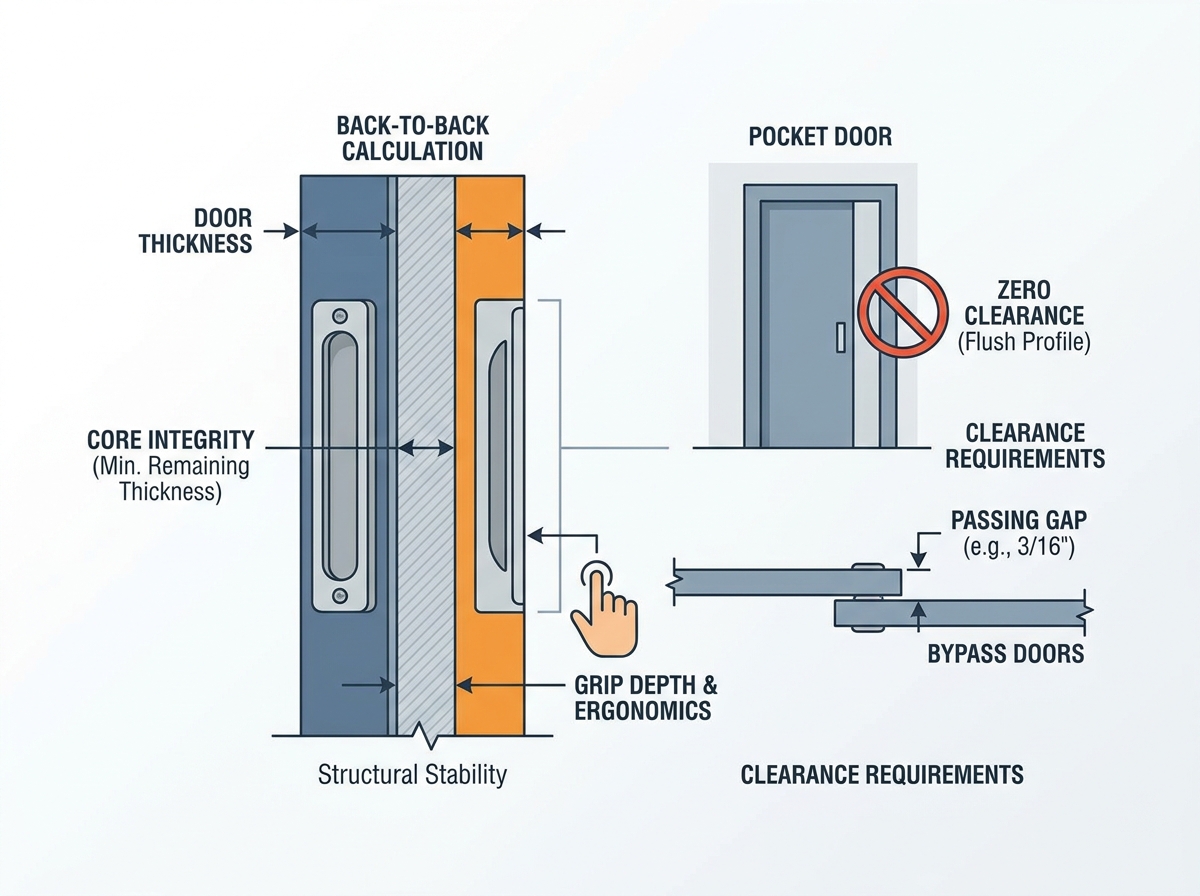
Every sliding track system operates under different physical constraints. You cannot apply a universal clearance rule across all door types. Precise gap management prevents daily operational failures.
Pocket systems demand rigorous spatial planning. You must evaluate the absolute necessity of a "true flush" profile. True flush means the hardware face sits completely level against the wood. Sub-flush profiles sit slightly below the panel surface. Both profiles ensure the door fully retracts into the wall cavity. You risk scratching the jamb if any lip protrudes. Proper pocket door hardware eliminates friction points completely. Measure the cavity width carefully before finalizing your pull depth.
Bypass doors operate on parallel tracks. They must slide past one another without collision. You need to calculate the passing gap between two overlapping active panels. The industry standard passing gap typically measures 3/16 to 1/4 inches. A protruding handle lip will violently strike the passing door face. Always specify zero-profile hardware for the inner passing faces. Outer faces can tolerate slight protrusions if space permits.
Surface-mounted tracks offer a different set of dimensional rules. You must account for baseboards, wall trim, and track standoff distances. The standoff distance dictates the gap between the panel and the drywall. Barn door handles allow for slight surface protrusions on the wall side. These systems offer more flexibility for semi-flush or thicker pulls. You still must verify the handle will not strike the baseboard during travel.
Door System Type | Required Hardware Profile | Standard Minimum Passing Gap | Primary Risk Area |
|---|---|---|---|
Pocket System | True Flush or Sub-Flush | N/A (Must clear split jamb) | Jamb scratching, cavity jamming |
Bypass System | True Flush (Inner Face) | 3/16" to 1/4" | Panel collision, deep scratches |
Barn Door System | Semi-Flush Allowed | 1/2" to 3/4" (Wall standoff) | Baseboard or trim strikes |
A handle serves as your primary tactile interface. Its internal shape dictates how easily you can move the door. We must match human ergonomics directly to the panel's physical mass.
Every sliding system has initial rolling resistance. You must exert force to break the static friction of the rollers. Match the finger-grip recess cup depth to the slab weight. Hollow-core doors weigh very little. They easily tolerate shallow, unangled pulls. Heavy glass or solid wood doors present a different challenge. They require deeper cups and sharply angled interior lips. These angled lips let your fingers hook securely into the metal. A weak grip on a heavy panel causes finger slip and frustration.
High-frequency environments demand specific hardware traits. You must identify handles built for constant, heavy use. We assess edge-finishing carefully inside the recess cup. Sharp interior machining marks can cause user injury over time. Residential hardware often uses simple stamped metal. Commercial pulls utilize cast or CNC-machined bodies. Smooth, chamfered internal edges prevent discomfort during repetitive opening cycles.
Standard recessed pulls often fail accessibility guidelines. Users possessing limited grip strength struggle to operate shallow cups. ADA compliance generally requires operable parts needing no tight grasping or pinching. Deep, oversized pulls can sometimes mitigate this issue. However, you should evaluate alternative architectural hardware when strict compliance is necessary. Extended loop pulls or specialized levers serve restricted-mobility users better.
Aesthetics often drive initial hardware selection. Real-world longevity, however, relies entirely on material science and fastening methods. You must analyze the environment before choosing the finish.
Base materials determine the lifespan of the hardware. Stainless steel offers excellent corrosion resistance. Use 304 grade steel for standard interior residential applications. You must upgrade to 316 grade steel for exterior or wet environments. Zamak and zinc alloys provide cost-effective alternatives for dry zones. We also assess how finishes hold up to continuous friction. Matte black and brushed nickel remain highly popular. PVD coatings offer superior resistance against acidic finger oils. Cheaper powder coats will chip and flake away over time.
Fastener visibility involves both aesthetic and functional trade-offs. Exposed screws offer incredibly simple installation and removal. They also present a slightly industrial appearance. Concealed systems use internal mounting brackets. They provide a sleek, unbroken visual surface. However, concealed systems require much tighter mortise tolerances. Accurate cuts ensure the cover plates snap firmly into place. They also prevent clothing snags during close passes.
Some hardware utilizes glue-in or press-fit installation methods. These pulls often fail in high-traffic or climate-variable environments. Vibration from rolling tracks gradually weakens adhesive bonds. Wood expansion pushes friction-fit cups right out of their mortises.
Avoid adhesives on solid wood exterior doors.
Avoid friction-fit hardware on heavy glass panels.
Accept adhesive methods only for lightweight cabinet sliders.
Mechanical fastening always provides superior long-term stability.
Even premium hardware fails if installed poorly. The installation phase introduces significant risk to the door panel. You must plan the mortising process meticulously.
Precision is non-negotiable for flush installations. We strongly advise using CNC routing or precision templates. Freehand chiseling almost always results in sloppy fits. Visible gaps around the hardware flange look unprofessional. A precise router template guarantees tight, uniform edges. It also prevents accidental splintering of the door veneer. Masking the cut area prevents surface scratching during tool operation.
Replacing old hardware introduces unique sizing problems. Upsizing an existing cutout is surprisingly difficult. The router lacks solid center material to guide the pilot bit. Buyers must measure the exact bounding box of their current hardware. Always order replacements slightly larger than the existing hole. This sizing strategy lets you carve a fresh, clean edge. Trying to fill gaps around a smaller replacement handle rarely succeeds.
Over-routed cutouts cause persistent hardware play. A loose handle rattles loudly every time the door moves. You must address this micro-movement immediately. We inject high-grade silicone bedding behind the handle flange. The silicone cures to form a flexible, vibration-dampening gasket. You can also use custom plastic shims for severe gaps. A tight fit ensures quiet, premium-feeling door operation.
Choosing the correct sliding door hardware requires a systematic approach. You must balance the physical mass of the door against track clearances and structural safety. Following a strict decision sequence guarantees a flawless installation.
Shortlist methodically: First, measure your exact door thickness. Next, determine your sliding system clearance rules. Then, calculate the maximum safe cutout depth. Finally, select an appropriate ergonomic grip and durable material.
Verify core stability: Never compromise the internal wood structure just to fit a deeper handle.
Consult the experts: Advise buyers to verify track clearances carefully. Always consult a millwork provider before finalizing any expensive hardware order.
Prioritize mechanics: Choose mechanically fastened pulls over adhesive options for longevity.
Your hardware dictates the daily experience of the space. Treat the selection process as a crucial structural decision.
A: Standard depth usually ranges from 3/8 inch to 5/8 inch. The exact depth you can use depends entirely on your door thickness. Thicker panels safely accommodate deeper cups. Always calculate the remaining core material before finalizing your purchase.
A: No, you generally cannot do this without modification. Standard depths will remove too much material, causing structural failure. You must install solid blocking inside the door stile to support the hardware. Specialized shallow pulls also provide a temporary workaround.
A: The industry standard passing clearance rule dictates a 3/16 inch gap. Some systems allow up to 1/4 inch. Your hardware must sit perfectly flush or sub-flush on the inner faces. Protruding handles will strike the adjacent panel.
A: They remain interchangeable in theory. However, barn door tracks allow for greater projection on the wall-facing side. Pocket doors require absolute zero-profile installations to enter the wall cavity. Barn doors offer more flexibility for semi-flush hardware selections.


