

Views: 0 Author: Site Editor Publish Time: 2026-10-26 Origin: Site


Moving inventory inefficiently drains warehouse productivity. It also increases the risk of product damage or sudden workplace injury. Relying on improper transport equipment forces workers to physically compensate for systemic design flaws. This leads to premature worker fatigue. Selecting the right material handling equipment comes down to geometry. You must carefully match the trolley’s structural design to your specific load type and operational environment. A physical mismatch often leads to dropped items or unsafe lifting practices on the factory floor.
This guide provides a direct comparison between flatbed versatility and basket-enclosed security. It will help you finalize your equipment procurement decision. Facility managers face endless equipment catalogs daily. Navigating these choices requires focusing on core handling physics. We will explore those critical metrics below. You can confidently choose the exact cart required to conquer your daily handling tasks.
Foldable platform trucks excel in high-weight capacity applications for bulky, boxed, or irregularly shaped items that require a flat footprint.
Basket storage trolleys are non-negotiable for order picking, transporting loose items, or moving fragile goods that risk sliding off flat surfaces.
Equipment selection should be driven by three metrics: average load weight, load stability (loose vs. boxed), and available storage footprint in your facility.
Advanced platform models now feature stretchable bases, offering a hybrid solution for varying load sizes without sacrificing storability.
Before purchasing new equipment, you must identify where your current workflows break down. Many facilities deploy incorrect cart types. This forces employees into awkward ergonomic positions. It also slows down daily transit speeds. We recommend auditing your current material flow using specific operational metrics.
You should follow these steps to audit your environment:
Audit Your Load Profile: Determine if your primary handling tasks involve consolidated bulk items or high-mix inventory. Pallets and large boxes require open surfaces. Conversely, loose inventory demands enclosed spaces to prevent mid-transit spills.
Evaluate Operational Terrain: Analyze your floor surfaces. Factory floors, retail aisles, and warehouse environments demand different maneuverability clearances. A highly polished retail floor requires softer wheels. A debris-heavy dock requires rugged casters capable of crossing uneven thresholds.
Storage Constraints: Assess the square footage available for storing material handling equipment. When not in active use, large carts consume valuable aisle space. You must measure designated parking zones to ensure compliance with occupational safety clearances.
Industrial engineering standards emphasize matching the tool to the task. If your workers constantly shrink-wrap small items just to cross a warehouse, you have an equipment bottleneck. Recognizing these friction points simplifies your subsequent purchasing choices.
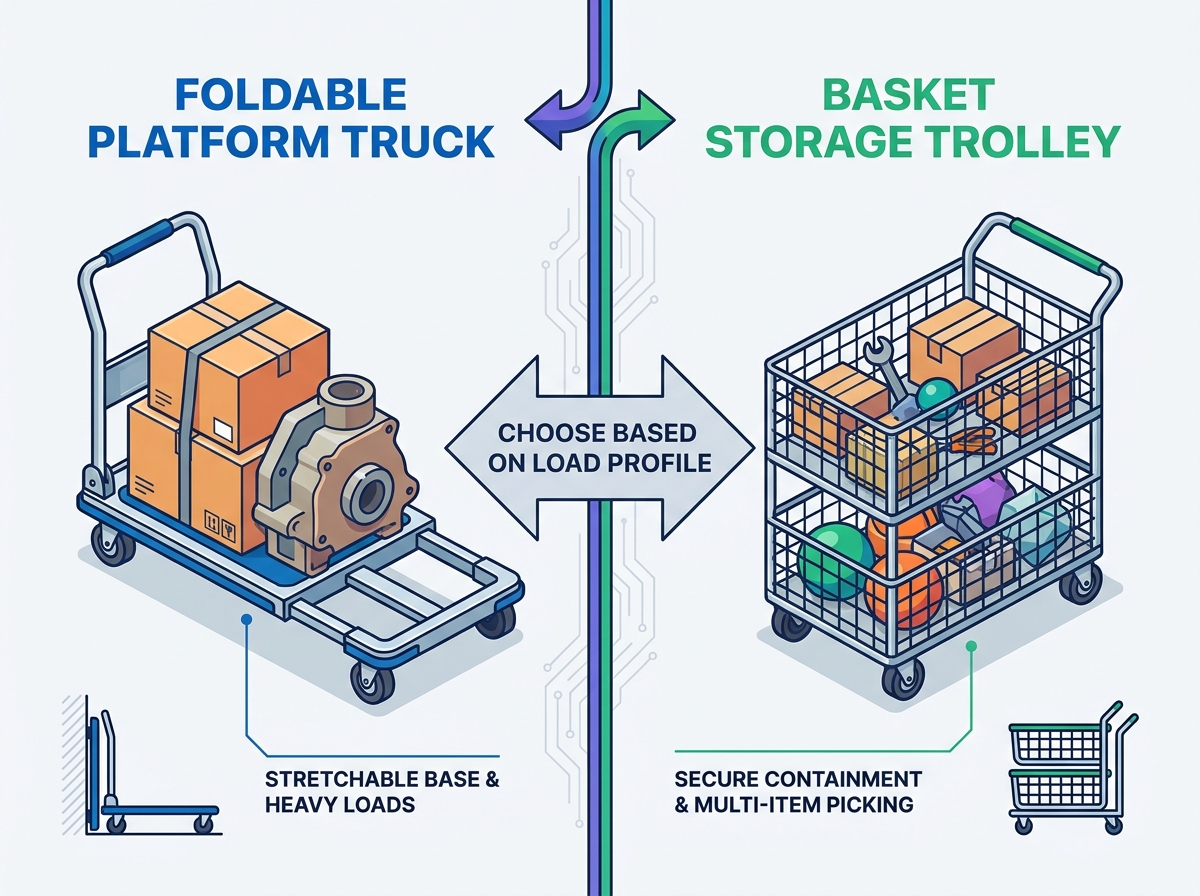
Heavy, consolidated loads require unhindered surface areas. Foldable platform trucks serve as the backbone of industrial material transport. They thrive in factories, receiving docks, and bulk transit operations. Items strapped, boxed, or inherently heavy sit perfectly on these flat decks.
These units deliver distinct structural advantages for heavy-duty applications:
Unrestricted Edges: The flat deck allows for loading items wider than the wheelbase. Workers can safely transport oversized plywood, large machinery parts, or long pipes. They do not face vertical wall constraints.
High Weight Capacities: Engineers design these bases for extreme static and dynamic loads. A reinforced flatbed distributes weight evenly across all four casters. This prevents deck bowing under central pressure.
Stretchable Designs: Modern models feature extendable flatbeds. These telescopic bases accommodate oversized loads during transit. Once emptied, they retract for highly compact storage. This dual-functionality transforms limited storage areas into efficient parking zones.
However, you must consider certain physical limitations. A lack of side retention means a higher risk of load spillage. If workers improperly stack or poorly shrink-wrap items, sudden stops will scatter inventory. Flatbeds demand disciplined stacking protocols. You must place the heaviest boxes at the bottom. You also need straps for highly unstable vertical loads.
When handling hundreds of small, unboxed items, a flatbed fails completely. Basket storage trolleys solve this issue through total perimeter containment. They shine in e-commerce order picking, retail restocking, and busy mailrooms. Workers frequently use them for transporting small, loose, or cylindrical components.
The enclosed design offers massive operational benefits. Mesh or solid walls eliminate the need to balance items carefully. You never have to strap down components. This structure allows for a rapid "toss and go" workflow. Pickers can literally throw items into the basket while walking down an aisle. This speeds up multi-item collection tasks dramatically.
Many units also feature tiered or multi-level designs. These shelves improve sorting accuracy. A picker can separate orders by client, department, or shipping zone directly on the cart. This reduces secondary sorting times back at the packing station.
Despite these benefits, you face strict dimensional constraints. You cannot transport items wider or longer than the basket’s internal dimensions. Rigid walls block overhangs entirely. Furthermore, these enclosed units generally offer a lower overall weight capacity compared to heavy-duty flat platforms. They prioritize volume and security over sheer tonnage.
Choosing between these two formats requires a side-by-side analysis of your daily demands. We break down the decision into three primary evaluation criteria. This framework ensures your final purchase aligns exactly with worker needs.
Platform trucks win when dimensions vary wildly. If your inbound freight includes long tubes, wide crates, and standard boxes, you need an open deck. You should prioritize flatbeds when items can be stacked securely. Gravity and friction keep properly stacked boxes in place.
Basket trolleys win when dimensions are small. You should prioritize these when item quantity and instability are high. If you move hundreds of loose bolts, soft garments, or rolling cylinders, enclosed walls are mandatory. They prevent continuous bending to retrieve dropped inventory.
Platform trucks dominate space efficiency. Their flat-folding handles allow them to slide under lower shelves. Some models even feature collapsible wheels. You can hang these compact units on warehouse walls or stack them vertically in tight utility closets.
Basket trolleys generally have a fixed, rigid footprint. Their tall walls do not fold flat. You must assign them dedicated parking zones. However, some wire-mesh models feature tapered designs. These specific models nest together like grocery carts, saving some floor space. Still, they consume far more cubic volume than a folded flatbed.
Worker safety hinges on reducing physical strain. You must compare the bending required for a floor-level platform truck versus the raised picking height of a standard basket unit. Flatbeds sit low to the ground. Workers must bend at the waist to load the initial base layers. This strains the lower back over a long shift.
Enclosed basket units often feature raised false bottoms or waist-high upper tiers. This keeps inventory within the optimal ergonomic strike zone. Workers grab items without bending or reaching excessively overhead.
You must also consider push/pull physics. Platform trucks require careful load distribution over the rear casters for safe steering. If a worker loads all the weight on the front swivel casters, the cart becomes impossible to steer accurately. National Institute for Occupational Safety and Health (NIOSH) guidelines strongly recommend pushing carts rather than pulling them. This reduces shoulder injuries and improves forward visibility.
Feature / Capability | Foldable Platform Trucks | Basket Enclosed Trolleys |
|---|---|---|
Primary Use Case | Heavy, bulky, or boxed items | Loose, small, or fragile items |
Weight Capacity | High (Industrial Grade) | Low to Medium |
Load Dimensional Limits | Unlimited (allows overhang) | Strictly limited by basket walls |
Storage Footprint | Highly compact (folds flat) | Rigid (requires dedicated parking) |
Loading Ergonomics | Requires bending to floor level | Waist-height access on upper tiers |
Integrating new carts into a fleet introduces maintenance cycles. You cannot simply deploy storage trolleys and ignore them. Proactive maintenance prevents catastrophic transit failures. The following components require your strict attention.
Caster wheels represent the primary failure point for all mobile equipment. Selecting the wrong wheel material destroys floors and frustrates workers. You must match the wheel hardness to your operational terrain.
Caster Material | Ideal Floor Type | Key Characteristic |
|---|---|---|
Polyurethane (PU) | Smooth factory concrete | High load rating, non-marking, highly durable. |
Pneumatic / Rubber | Uneven outdoor docks | Absorbs shock, rolls over debris smoothly. |
Nylon | Carpet or oily surfaces | Resists chemicals, very low rolling resistance. |
Hinge and joint fatigue pose severe risks for foldable models. Folding mechanisms introduce moving parts to a load-bearing frame. You must emphasize the need for regular inspection. Maintenance teams should check the locking pins and folding hinges weekly. A worn hinge pin can cause a flatbed handle to collapse mid-transit, injuring the operator.
Sanitation requirements also dictate equipment choices. Mesh baskets can accumulate dust, cardboard fibers, and debris in their internal corners. They require thorough pressure washing or detailed air-blowing. In food-grade facilities or medical clean-rooms, flat platforms perform better. A flat, wipeable surface allows for rapid, compliant sterilization.
Selecting the right transport cart fundamentally improves your operational safety and daily throughput. The final verdict depends on your specific handling geometry. Choose foldable platform trucks for heavy, boxed, or oversized loads where storage space remains at a premium. These flatbeds offer unmatched structural freedom. Alternatively, choose basket storage trolleys if your workflow demands rapid handling of loose, unsecured items. Enclosed walls remove the primary risk of dropping valuable inventory mid-transit.
Your next steps require precise facility measurements. First, measure your narrowest aisle to ensure turning clearance. Next, weigh your heaviest average payload to establish your baseline capacity requirement. Finally, run a pilot test. Procure one of each unit and observe your workers interacting with them during a full shift. This real-world test provides definitive proof before committing to a fleet-wide purchase.
A: Yes, provided you select an industrial-grade model. You must focus on the structural integrity of the folding joint. High-end foldable models use reinforced steel locking brackets. These match the weight ratings of fixed models. However, budget consumer models use weak plastic hinges. They will fail under heavy factory loads.
A: Yes. Many manufacturers offer platform trucks with removable wire basket attachments or drop-in side-rails. Workers can attach the mesh walls when picking loose items. They can subsequently remove the walls when transporting oversized flat boxes. This provides total operational flexibility.
A: Stretchable capacity refers to telescopic base designs. The flatbed length physically expands. You unlock a mechanism and pull the deck outward to accommodate longer oversized boxes. When finished, you push the deck back together. This maintains a small storage footprint while adapting to changing load sizes.
A: You must calculate the load rating per caster and assess your flooring. Divide your total max load by three to find the required capacity per wheel. Use hard polyurethane (PU) wheels for heavy loads on smooth indoor concrete. Use soft rubber or pneumatic wheels for uneven thresholds or outdoor gravel.


